



Popular Articles
Ultimate Guide to 360° Comprehensive Interior Detailing — Deep Clean, Sanitize and Protect Your Car’s Cabin
2026.02.04
Singapore Car Window Tinting Guide: Rules, Benefits, and How to Choose the Right Film
2026.02.04
The Complete Guide to Colour Wraps — Transforming Your Car’s Look with Style and Protection
2026.02.04
About Company
Colorfuul is a global leader in high-end automotive films, offering Color TPU PPF, Transparent PPF, PET Window Films, and Vinyl Wrapping. With exports to over 100 countries, we deliver consistent quality, competitive pricing, and professional service. Beyond production, we provide OEM/ODM customization, shaping the future of automotive aesthetics.
 mary@colorfuul.com
  86 13541196952
 Colored PPF Durability & Lifespan: The Complete Guide to Long-Term Protection
For years, car enthusiasts were forced to make a difficult trade-off. If you wanted to change the color of your vehicle to something unique—like a deep Midnight Purple or a sleek Chalk Grey—you used vinyl wrap. If you wanted to actually protect the paint from rock chips and scratches, you used clear Paint Protection Film (PPF).
You couldn't have both. Vinyl offered style but zero protection and a short lifespan. Clear PPF offered protection but couldn't change your style.
That era is over. Colored Paint Protection Film (Colored PPF) has bridged the gap, offering the aesthetic transformation of a wrap with the heavy-duty armor of traditional PPF. But for those considering this significant investment, the big question remains: How long does it actually last?
At Colorfuul, we believe in transparency. In this guide, we are going to break down the chemistry, the real-world durability, and the lifespan expectations of Colored PPF so you can decide if it’s the right "forever film" for your vehicle.
What is Colored PPF? (The Chemistry of Durability)
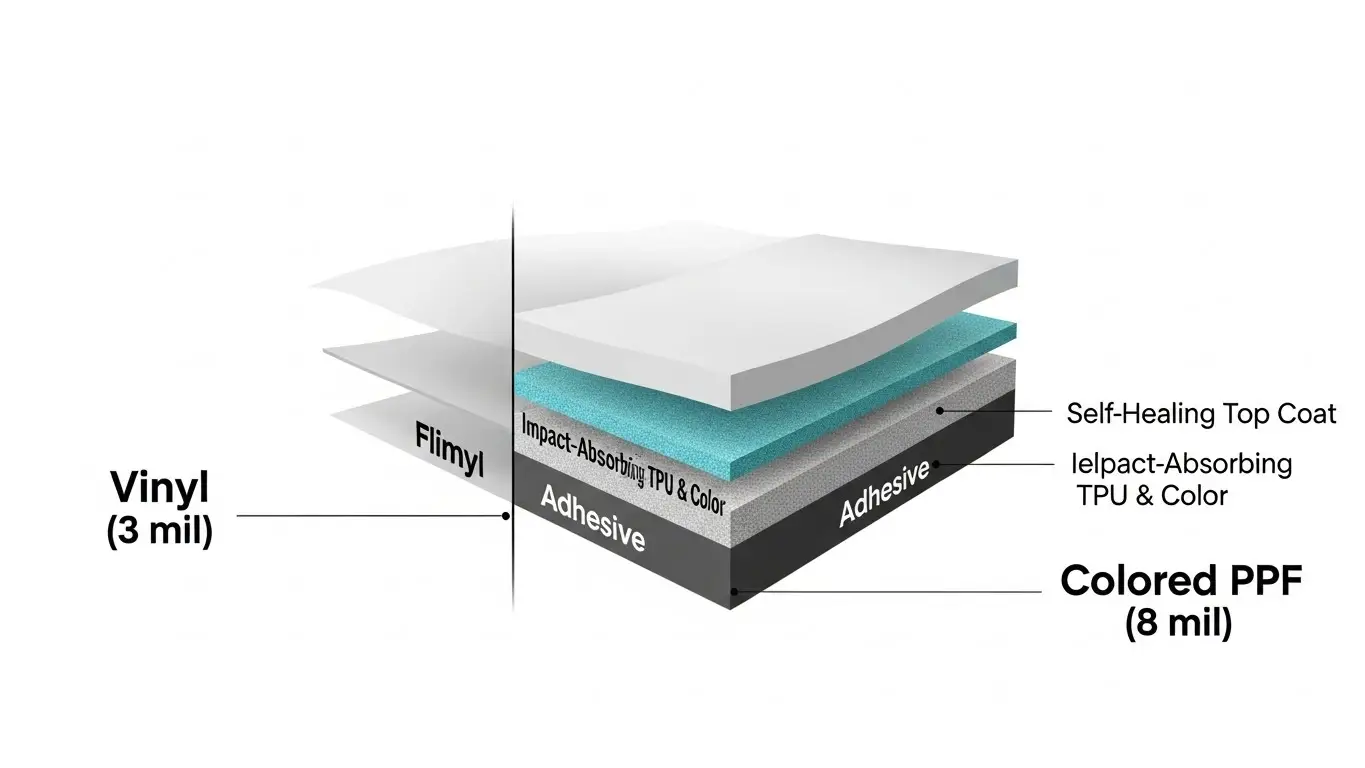
To understand lifespan, you have to understand construction. Many shops might tell you "it's like a thick vinyl," but that is chemically incorrect.
Vinyl wraps are made from Polyvinyl Chloride (PVC). PVC is a rigid material that requires plasticizers to become flexible. Over time, UV rays cook these plasticizers out, causing the vinyl to become brittle, crack, and fail.
Colored PPF is engineered from Thermoplastic Polyurethane (TPU). Unlike PVC, TPU is naturally elastomeric. It doesn't rely on volatile plasticizers to stretch.
A high-quality colored PPF typically consists of three critical layers fused together, usually totaling around 7.5 to 8 mils in thickness (compared to vinyl’s flimsy 3-4 mils):
- The Hydrophobic Top Coat: This is the self-healing layer. It seals the surface against contaminants and allows minor scratches to disappear with heat.
- The TPU Core with Pigment Infusion: In true colored PPF, the pigments are often infused directly into the TPU or a specialized stable bonding layer. This provides the impact absorption (shear resistance) necessary to deflect rocks.
- The Adhesive Layer: A formulated acrylic adhesive designed to grip the clear coat firmly without becoming permanent glue that damages the paint upon removal.
The Lifespan: How Long Does Colored PPF Last?
If you maintain it correctly, Colored PPF will last between 7 to 10 years.
This puts it in a completely different asset class than vinyl wraps. While a vinyl wrap is a temporary cosmetic change, Colored PPF is a long-term asset protection strategy. Because it utilizes Aliphatic TPU (a non-yellowing thermoplastic), the film is chemically stable against UV radiation.
Here is a breakdown of how Colored PPF stacks up against other surface protection options:
| Feature | Colored PPF | Vinyl Wrap | Ceramic Coating |
| Estimated Lifespan | 7 - 10 Years | 3 - 5 Years | 2 - 5 Years |
| Material | TPU (Thermoplastic Polyurethane) | PVC (Polyvinyl Chloride) | SiO2 (Liquid Polymer) |
| Impact Protection | High (Rock Chips/Scratches) | Minimal to None | None (Chemical only) |
| Self-Healing | Yes (Heat activated) | No | No |
| Finish Texture | High Gloss (Wet Paint Look) | Orange Peel Texture | Enhances existing paint |
When we talk about "lifespan," we refer to the duration the film performs its two primary jobs: looking good (no fading/cracking) and protecting the paint (absorbing impact).
Key Factors Influencing Durability
While 7-10 years is the industry standard, real-world results depend on a few variables. We’ve seen films look brand new after 8 years, and we've seen neglected films struggle at year 5. Here is what moves the needle.
1. UV Exposure and Aliphatic Chemistry
The sun is the enemy of all polymers. However, premium Colored PPF uses Aliphatic TPU, which is chemically resistant to oxidation and yellowing. Cheaper, "white-label" films often use Aromatic TPU, which will yellow and turn brittle within two years.
For colored films, specifically, UV stability ensures the pigment doesn't fade. A Nardo Grey shouldn't turn into a nebulous beige. The quality of the pigment infusion process dictates this stability.
2. Road Debris and Impact
The elasticity of TPU allows it to absorb the kinetic energy of a flying stone. Instead of chipping, the material deforms and then bounces back. However, constant bombardment in harsh environments (like daily highway driving in construction zones) can eventually scar the surface texture over a decade.
3. Chemical Resistance
Road salts, bird droppings, and bug splatter are acidic. Colored PPF is highly resistant to these, but it isn't invincible. If bird lime is left to bake on the surface for weeks under a hot sun, it can eventually etch the top coat. The hydrophobic layer buys you time—usually days or weeks—to wash it off, whereas clear coat might etch in hours.
4. Installation Quality
This is often overlooked. If an installer over-stretches the film (beyond 30-40% tension) around complex curves, they thin out the protective layer and the color pigments. This creates weak points that are more susceptible to debris and lifting.
Colored PPF vs. Vinyl Wrap: The Durability Showdown
We often get asked in our colored PPF vs. vinyl wrap comparisons, "Why should I pay more for Colored PPF when Vinyl looks similar?"
The truth is, they don't look similar after 12 months, and they certainly don't perform the same.
Scratch Resistance:
Vinyl is soft and prone to "micro-marring." Every time you wash a vinyl-wrapped car, you introduce fine swirl marks that permanently dull the finish. Colored PPF is self-healing. Those swirl marks from washing? They disappear the next time the car sits in the sun or you run hot water over it.
The "Orange Peel" Effect:
If you look closely at a vinyl wrap, you will see a texture that looks like the skin of an orange. It distorts reflections. High-quality Colored PPF lays down incredibly flat. Because it is thicker and wet-applied, it mimics the depth and clarity of factory "wet" paint.
Removal:
This is the nightmare scenario no one talks about. Remove a vinyl wrap after 5 years, and it often comes off in tiny shards, leaving heavy glue residue that requires hours of labor and harsh solvents to remove. Colored PPF, even after 7-10 years, generally peels off in large, clean sheets, leaving the OEM paint underneath in pristine condition.
Real-World Durability Scenarios
Let's look at how this material handles actual driving conditions.
- The Highway Commute: At 70 mph, a small pebble hits with significant force. On bare paint or vinyl, this chips the finish immediately, leading to rust risk. With Colored PPF, the film absorbs the hit. You might see a tiny indentation, but the paint underneath remains sealed.
- The Parking Lot: We’ve all returned to our car to find a scuff on the bumper from a shopping cart. With vinyl, the wrap would tear, revealing the original paint color underneath—a dead giveaway. With Colored PPF, the scuff usually wipes off. If the film didn't tear through (which is hard to do), the color consistency remains perfect.
- Harsh Winters: Salt and brine are corrosive. Colored PPF provides a hermetic seal over your body panels. As long as you wash the salt off periodically, the film prevents that corrosion from ever touching your metal or clear coat.
Maintenance: Extending the Life of Your Film
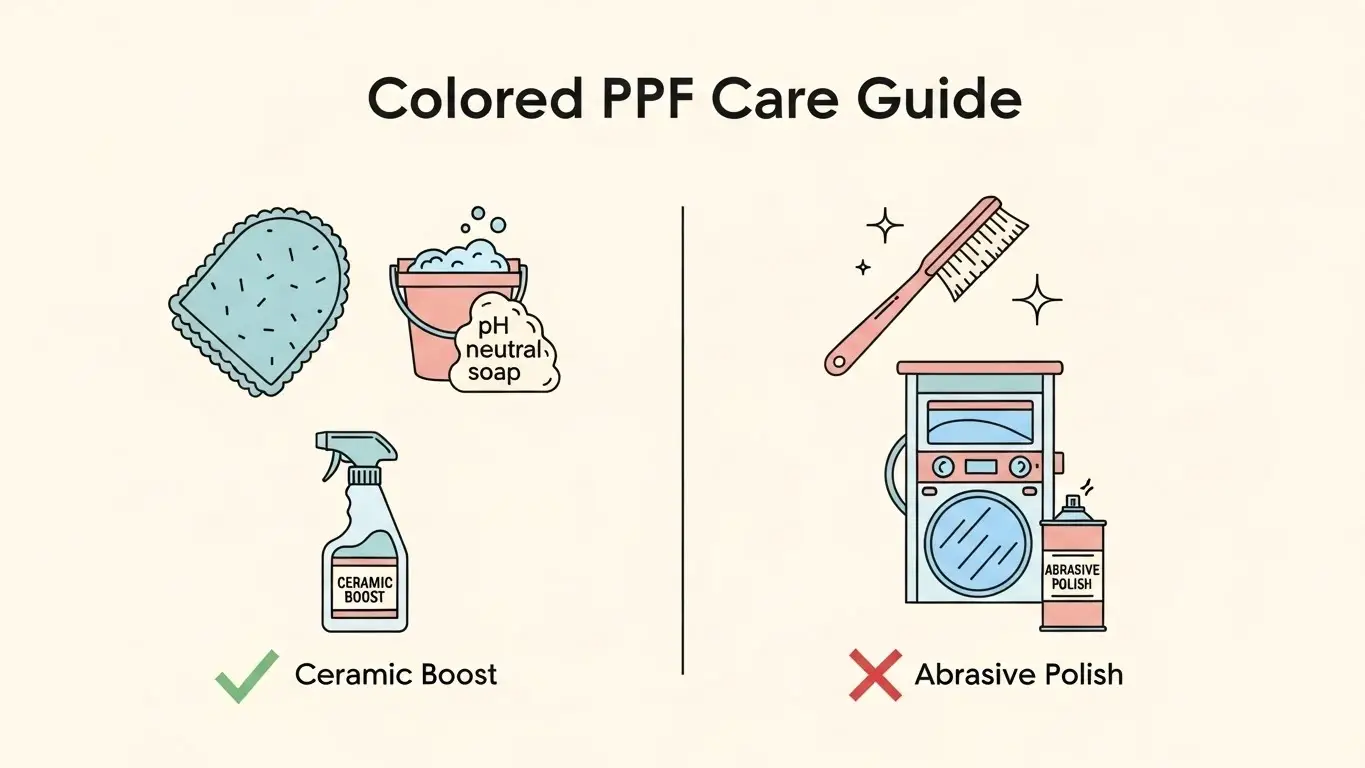
Just because it's durable doesn't mean it's maintenance-free. Think of Colored PPF like leather boots—they are tough, but they last longer if you condition them.
The Golden Rules of Maintenance:
- Wait 7 Days: Do not wash the vehicle for the first week after installation to allow the moisture from the application process to evaporate and the adhesive to cure.
- Two-Bucket Wash: Always use the two-bucket method to minimize dirt grinding into the film.
- Avoid Abrasives: Never use cutting compounds, heavy polishes, or stiff brushes on PPF. You don't want to abrade the self-healing top coat.
- Top It Off: While Colored PPF is hydrophobic, adding a dedicated ceramic coating for PPF adds a "sacrificial layer" that makes cleaning even easier and further blocks UV rays.
Signs It's Time for Replacement
Nothing lasts forever. Even the best film will eventually retire. Here is when you know you've gotten your money's worth and it's time to refresh:
- Heavy Delamination: If the film starts lifting significantly at multiple edges.
- Saturation: If the film has taken so many rock hits that the texture looks rough or "sandblasted."
- Loss of Hydrophobicity: If water lays flat on the surface and heat no longer heals scratches, the top coat has worn down.
FAQ
Does colored PPF fade in the sun?
High-quality colored PPF manufactured with aliphatic TPU is extremely resistant to fading. Unlike vinyl, which can fade significantly in 2-3 years, colored PPF maintains true color depth for its entire 7-10 year lifespan.
Can I wax or polish colored PPF?
You should not use abrasive polishes or waxes containing naphtha or kerosene, as these can damage the self-healing top coat. Instead, use sealants or ceramic coatings specifically formulated for PPF.
Is colored PPF removable without damaging paint?
Yes. If the paint underneath is original factory paint (OEM), colored PPF can be removed safely even after years of use. It typically leaves little to no adhesive residue, unlike vinyl wraps.
Why is colored PPF more expensive than vinyl?
The cost reflects the material engineering. You are paying for a 300% thicker material, self-healing capabilities, and a 10-year lifespan compared to a 3-year lifespan. It is a functional protective product, not just a cosmetic sticker.
Is colored PPF self-healing?
Yes. The top layer of the film is elastomeric. When exposed to heat (sunlight, hot water, or a heat gun), the polymer chains realign, causing fine scratches and swirl marks to disappear.
Conclusion
Choosing Colored PPF is a decision to prioritize quality over compromise. It allows you to customize your vehicle with the stunning aesthetics of a color change while resting easy knowing your investment is armored against the elements.
While the upfront cost is higher than a vinyl wrap, when you ask is colored PPF worth it?, the math makes sense. Over a 7-year period, you would likely need to pay for two or three vinyl wrap jobs to match the longevity of a single Colored PPF installation.
If you are ready to protect your vehicle with the most advanced film technology available, explore Colorfuul’s range of long-lasting colored PPFs and find the perfect shade for your ride.


