



Popular Articles
Ultimate Guide to 360° Comprehensive Interior Detailing — Deep Clean, Sanitize and Protect Your Car’s Cabin
2026.02.04
Singapore Car Window Tinting Guide: Rules, Benefits, and How to Choose the Right Film
2026.02.04
The Complete Guide to Colour Wraps — Transforming Your Car’s Look with Style and Protection
2026.02.04
About Company
Colorfuul is a global leader in high-end automotive films, offering Color TPU PPF, Transparent PPF, PET Window Films, and Vinyl Wrapping. With exports to over 100 countries, we deliver consistent quality, competitive pricing, and professional service. Beyond production, we provide OEM/ODM customization, shaping the future of automotive aesthetics.
 mary@colorfuul.com
  86 13541196952
 What Are the Pros and Cons of Colored PPF vs Vinyl Wrap?
Colored PPF offers superior protection and longevity (7-10 years) with self-healing TPU technology that prevents rock chips, while Vinyl Wrap is a thinner, aesthetic-only solution that lasts 3-5 years. While Vinyl is 30-40% cheaper upfront, Colored PPF mimics real paint without "orange peel" and protects your vehicle's resale value, making it the better long-term investment for 2026.
Why This Matters
For car enthusiasts and luxury vehicle owners, the choice between Colored Paint Protection Film (PPF) and Vinyl Wrap isn't just about changing color—it's about asset management. In 2026, the automotive styling market has shifted. You no longer have to choose between the custom look of a wrap and the armored protection of PPF.
At Colorfuul, we see thousands of customers struggle with this decision. Choosing the wrong material can lead to damaged paint, peeling film after just two years, or thousands of dollars in wasted installation fees. Understanding the distinct differences between thermoplastic polyurethane (TPU) used in PPF and polyvinyl chloride (PVC) used in vinyl is critical for protecting your investment.
The Core Difference: Protection vs. Aesthetics
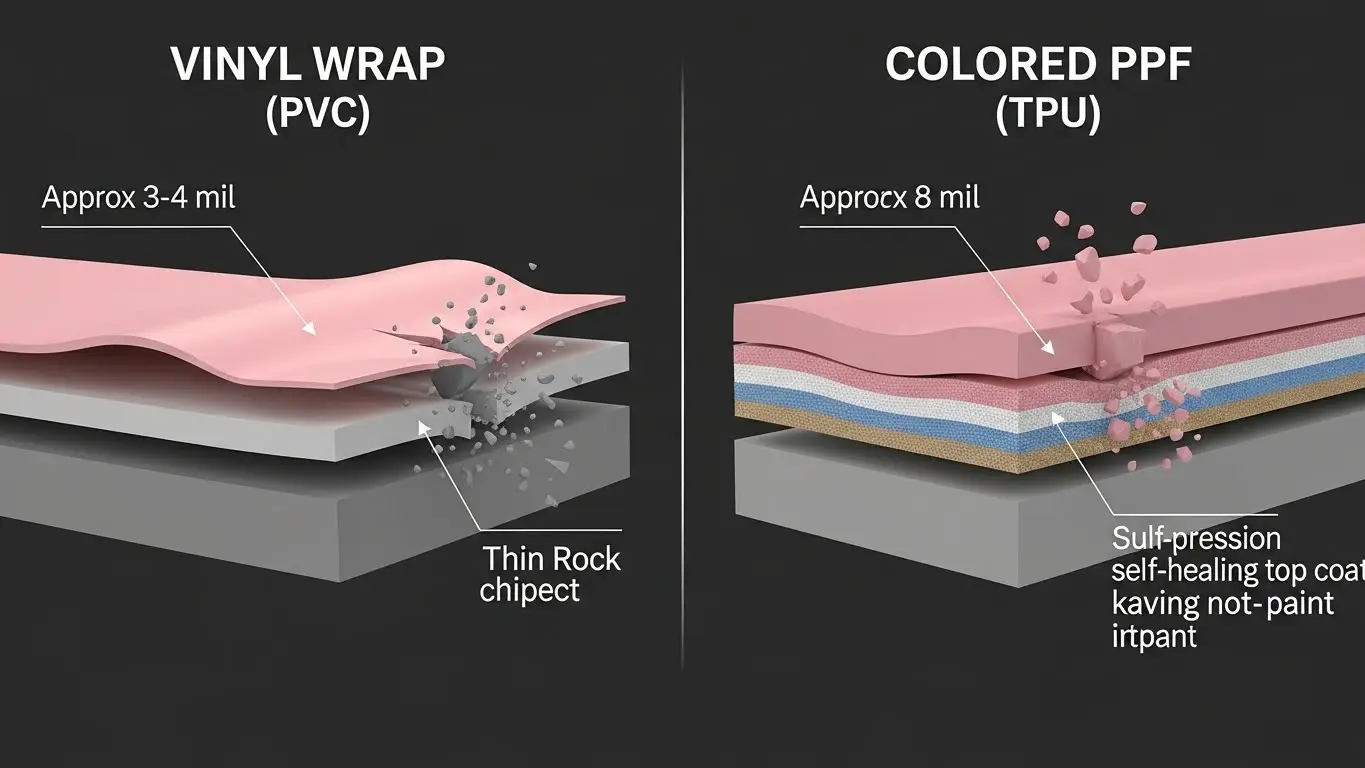
The fundamental difference lies in the material science.
Vinyl Wrap is primarily for style. Think of it as a high-quality sticker. It’s thin (usually 3-4 mils), flexible, and comes in thousands of finishes. However, it offers virtually no impact protection. A flying pebble at highway speeds will tear right through vinyl and chip your paint.
Colored PPF is for performance. It is a thick (8+ mils), impact-resistant shield made from TPU. It combines the color-changing ability of vinyl with the self-healing, rock-blocking power of traditional clear bra. It is designed to take a beating so your clear coat doesn't have to.
Detailed Comparison: Colored PPF vs. Vinyl Wrap
Here is how the two stack up in real-world performance metrics for 2026.
| Feature | Vinyl Wrap | Colored PPF (Colorfuul TPU) |
| Primary Material | PVC (Polyvinyl Chloride) | TPU (Thermoplastic Polyurethane) |
| Thickness | 3 - 4 mils | 7.5 - 8+ mils (2x thicker) |
| Lifespan | 3 - 5 Years | 7 - 10 Years |
| Rock Chip Protection | ❌ Minimal / None | ✅ Excellent |
| Self-Healing | ❌ Rare (only high-end brands) | ✅ Standard (Heals with heat) |
| Surface Finish | Often has "Orange Peel" texture | Flat, glass-like "Paint" finish |
| Hydrophobic | Varies by brand | ✅ Native Hydrophobic Top Coat |
| Cost (Installed) | $$($2,500 - $4,500) | $$$ ($4,000 - $7,000+) |
Deep Dive: Pros and Cons
Colored PPF: The Premium Choice
Pros:
- Self-Healing Technology: Swirl marks and fine scratches disappear when exposed to the sun or warm water.
- Real Paint Aesthetics: High-quality colored PPF, like our Color TPU series, has a depth and clarity that mimics factory paint, eliminating the rippled "orange peel" look common with vinyl.
- Superior Durability: It resists yellowing, staining from bird droppings, and chemical etching much better than vinyl.
- Resale Value: Because it protects the paint underneath from actual damage, your car stays "showroom new" beneath the film.
Cons:
- Higher Cost: The raw material (TPU) is significantly more expensive to manufacture than PVC.
- Complex Installation: It requires a "wet" installation process which takes longer and demands higher skill than dry-apply vinyl.
- Limited Palette: While growing, the color options are fewer than the infinite catalog of vinyl prints.
Vinyl Wrap: The Customization King
Pros:
- Infinite Variety: From chrome and color-shifting to intricate printed graphics, vinyl offers unlimited design freedom.
- Lower Upfront Cost: A great option for leased vehicles or those who want to change their car's color every 2-3 years.
- Easier Removal: Generally easier to strip off if removed within the recommended 3-year window.
Cons:
- Zero Impact Protection: It will not stop rock chips, scratches, or door dings.
- Short Lifespan: UV rays degrade PVC faster, leading to fading or cracking if left on too long.
- Orange Peel: The finish often looks like a wrap, not like paint.
Cost Breakdown: Is PPF Worth the Extra Money?
Pricing varies heavily by location and vehicle size, but here is the 2026 market average for a full vehicle application:
- Standard Vinyl Wrap: $2,500 – $4,000
- Colored PPF: $4,500 – $7,000
The "Value" Equation:
If you keep a Vinyl Wrap for 3 years, your cost is roughly $1,000 per year.
If you keep Colored PPF for 7 years, your cost is roughly $785 per year.
💡 Insight: While Colored PPF is 40-50% more expensive upfront, it is often cheaper over the life of the vehicle ownership because you don't have to replace it as quickly, and it saves you money on paint repairs.
Common Mistakes to Avoid
- Ignoring the "Removal Date": Leaving vinyl on past its 3-5 year life can cause the adhesive to bond with your clear coat, leading to expensive paint damage upon removal.
- Mistaking "TPH" for "TPU": Some cheaper films are labeled TPH (a hybrid PVC). They are cheaper than real TPU but lack the self-healing and non-yellowing longevity of genuine Colorfuul TPU PPF.
- Applying Ceramic Coating Instead of PPF: Ceramic coatings are liquids; they do not stop rocks. Only PPF stops rocks.
- DIY Installation: Colored PPF is extremely difficult to install correctly. It is a wet application that requires specific slip solutions and squeegee techniques.
Expert Tips for 2026
- Check the Edges: A good installer wraps the film around the edges of the panels so no original color shows. Ask for "fully wrapped edges."
- The "Polished" Test: If you want the best look, ask to see a sample of the Colored PPF next to a sample of Vinyl. Look at the reflection of a light bulb. On Vinyl, the reflection will look fuzzy (orange peel). On PPF, it should be sharp.
- Maintenance Matters: Even though PPF is durable, using a pH-neutral car soap and a spray sealant every few months will extend its life to the full 10-year potential.
Frequently Asked Questions
Yes, significantly. Colored PPF is typically 7.5 to 8 mils thick, while vinyl wrap is usually only 3 to 4 mils thick. This extra thickness is what allows PPF to absorb the impact of rocks and road debris without damaging the paint underneath.
Absolutely. In fact, many high-end PPF products, including Colorfuul's lineup, come with a hydrophobic top coat already built-in. Adding a ceramic coating layer enhances this, making the car even easier to wash and providing extra protection against environmental fallout.
High-quality TPU PPF is UV-stable and resistant to fading. Unlike vinyl, which is known to fade or become brittle after prolonged sun exposure, Colored PPF is engineered to maintain its color depth and structural integrity for up to a decade.
Yes, it is fully removable. Because it uses high-quality adhesives designed for automotive paint, professional removal will not damage your factory finish. However, it adheres more strongly than vinyl, so professional removal is recommended to ensure it peels away cleanly.
Yes, to an extent. The thick adhesive layer of Colored PPF can fill in minor swirl marks and spider-webbing on your original paint, effectively hiding them. However, deep scratches or chips should be corrected before application for the smoothest possible finish.
The cost driver is the material itself. Thermoplastic Polyurethane (TPU) is a complex, high-performance material that is costly to manufacture compared to Polyvinyl Chloride (PVC). Additionally, the installation takes longer and requires more expertise, driving up labor costs.
Yes. One of the biggest advantages of Colored PPF is its lack of "orange peel" texture. Because it is a thicker, wet-applied film, it settles into a glass-like finish that is often indistinguishable from a high-quality factory paint job, unlike the textured look of vinyl.
A full vehicle color change with PPF typically takes 5 to 7 days. This includes washing, clay-barring, paint correction (if needed), removing trim/badges, wet application of the film, and drying time. Vinyl wraps are faster, often taking only 3 to 5 days.
Key Takeaways
- Protection First: Colored PPF is the only option if you want to prevent rock chips and scratches.
- Longevity: PPF lasts 2x longer (7-10 years) than Vinyl (3-5 years).
- Finish Quality: PPF offers a paint-like, high-gloss finish without the texture of vinyl.
- Budget: Vinyl is better for short-term style changes; PPF is an investment in vehicle value.
- Material: Always verify you are getting TPU material for maximum self-healing and durability.


