



Popular Articles
Ultimate Guide to 360° Comprehensive Interior Detailing — Deep Clean, Sanitize and Protect Your Car’s Cabin
2026.02.04
Singapore Car Window Tinting Guide: Rules, Benefits, and How to Choose the Right Film
2026.02.04
The Complete Guide to Colour Wraps — Transforming Your Car’s Look with Style and Protection
2026.02.04
About Company
Colorfuul is a global leader in high-end automotive films, offering Color TPU PPF, Transparent PPF, PET Window Films, and Vinyl Wrapping. With exports to over 100 countries, we deliver consistent quality, competitive pricing, and professional service. Beyond production, we provide OEM/ODM customization, shaping the future of automotive aesthetics.
 mary@colorfuul.com
  86 13541196952
 How Rare Is Midnight Purple GTR? Rarity, History & Cultural Impact
Midnight Purple GT-Rs are significantly rarer than high-volume colors like Arctic White or Sonic Silver, primarily because Nissan reserved these shifting violet tones for limited production windows and special edition models throughout the Skyline's history. This rarity matters because it has transformed a specific paint code into a cultural landmark, where the scarcity of the color reinforces the car's identity as a premium, "hero" version of an already legendary performance platform.
What Does “Rare” Mean for a Midnight Purple GTR?
Rarity for a Midnight Purple GTR is a combination of limited production frequency, high cultural recognition, and an intense level of enthusiast demand that far exceeds the number of surviving units. You should understand that "rare" in this context isn't just a technical count of how many cars left the factory; it is a measure of how often you actually encounter one in the wild compared to more common shades.
Technical rarity refers to the specific number of units assigned a certain paint code, while perceived rarity is driven by how the community prioritizes that color. Because Midnight Purple is so visually distinct and was often tied to significant milestones in the GT-R's development, it feels rarer than it might be on paper. You are looking at a color that was never intended for the masses; it was a specialized choice for a specific type of buyer, making it a rare sight at car meets and in private collections today.
How Common Was Midnight Purple on Nissan Skyline GT-R Models?
Midnight Purple appeared on Nissan Skyline GT-R models across three distinct generations, but its presence was never a permanent fixture in the standard color palette for the entire lifecycle of any model. You will find that the color’s history began with the R33 generation, where the original "Midnight Purple" (LP2) was introduced as a factory option that provided a dark, moody alternative to the brighter colors of the mid-90s.
While the R33 saw a respectable number of units in this shade, the color became much more segmented by the time the R34 arrived. For the R34 generation, Nissan treated Midnight Purple as an evolving concept rather than a single choice, introducing the color in three distinct "versions." Versions 2 and 3 were restricted to incredibly short production runs, often tied to the launch of the car or specific V-Spec editions. This tiered approach means that while "purple" as a general category exists across generations, the specific, high-shifting versions remain among the most elusive colors in Nissan's history.
Why Was Midnight Purple Most Strongly Associated With the R34 GT-R?
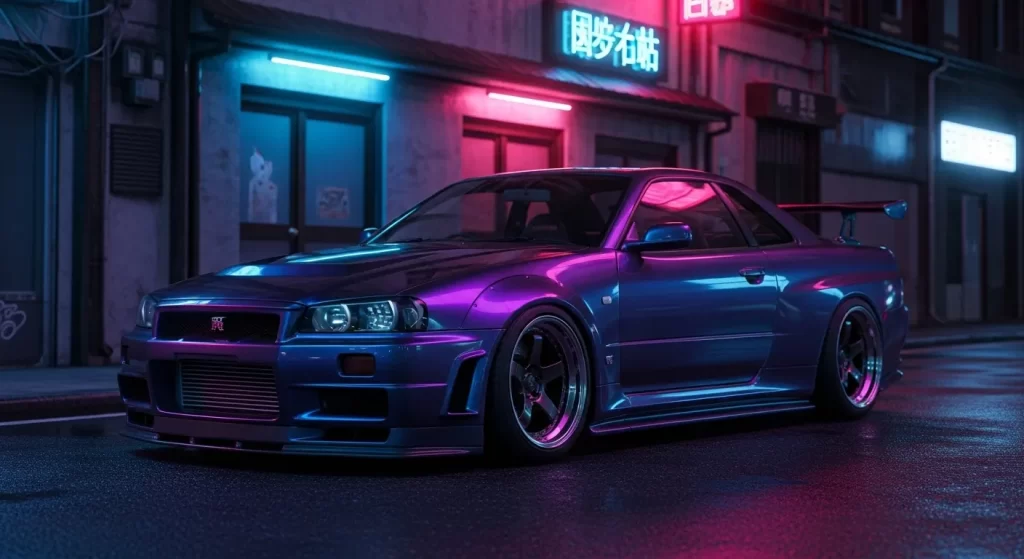
The color became tied to the R34 GTR specifically because of the platform's role in globalizing JDM culture and the high-tech, digital aesthetic that defined the turn of the millennium. You see a perfect alignment between the R34’s advanced engineering and the experimental nature of the Midnight Purple 2 and 3 finishes.
Key reasons for the R34 association:
- The "Hero" Color Status: Nissan used Midnight Purple 2 as the primary launch color for the R34, making it the face of the car in marketing and media.
- Technological Synergy: The color-shifting effect mirrored the car's reputation as a "moving computer," appealing to a generation of tech-focused enthusiasts.
- Aggressive Body Lines: The R34’s muscular fenders and sharp creases are uniquely suited to showing off the violet-to-blue "flip" of the paint.
- Limited Window: Because Versions 2 and 3 were only produced for a few months each, they became immediate symbols of exclusivity for that specific chassis.
What Is Midnight Purple 2 and How Does It Affect Rarity?
Midnight Purple 2 is a related variant influencing rarity conversation by shifting the focus from a dark, static violet to a highly reactive, blue-toned pearlescent finish. You will find that MP2 is often the version people are actually searching for when they talk about "rare" purple GT-Rs, as it represents a significant leap in paint technology compared to the original R33 shade.
| Version | Context | Tone Difference | Rarity Perception |
| Midnight Purple (LP2) | R33 Generation | Deep, dark violet; looks black in shade. | Moderate; respected as the original. |
| Midnight Purple 2 (LV4) | R34 Launch Phase | Blue-violet shift; highly metallic. | High; the iconic "chameleon" look. |
| Midnight Purple 3 (LX0) | R34 Later Phase | Purple-Blue-Gold; multi-chrome. | Maximum; the most complex and elusive. |
You notice that Midnight Purple 2 effectively "split" the rarity story. It made the original LP2 seem more common by comparison, while setting the stage for the even rarer Version 3. Because MP2 was the color used in the most famous promotional materials, it occupies a space where it is both the most "recognized" and one of the most "difficult to find" authentic examples on the market.
How Enthusiast and JDM Culture Drives Rarity Perception
Culture and visibility shape how rare Midnight Purple feels by elevating the color from a paint choice to a badge of "insider" status within the community. You find that in JDM rarity, the story told by enthusiasts is often more powerful than the actual production data. Because the color is so frequently discussed in forums, videos, and social media, its "legend" grows faster than the number of cars available.
Community storytelling focuses on the "unicorn" nature of the car. When you see a Midnight Purple GT-R at a show, it draws a crowd not just because it is beautiful, but because the community has collectively agreed that it is a "special" event to see one. This cultural feedback loop makes the color feel like a once-in-a-lifetime sighting. You are participating in a shared appreciation for a color that has been curated by decades of car culture as the definitive choice for the GT-R elite.
Is Midnight Purple Rarer Than Other GT-R Colors?
Midnight Purple is rarer than many GT-R colors, especially when compared to the high-volume whites, silvers, and blacks that make up the majority of the production run. While colors like "Bayside Blue" are also iconic, they were produced in much larger quantities over a longer period. In relative terms, you are much more likely to encounter a blue R34 than an authentic Midnight Purple 2 or 3.
However, you should note that it isn't the absolute rarest—there are ultra-limited edition colors like "Millennium Jade" or "Midnight Opal" that exist in even smaller numbers. But what makes Midnight Purple unique is its balance of rarity and recognition. While a one-of-ten beige car might be technically rarer, it lacks the cultural impact of Midnight Purple. You get a color that is rare enough to be exclusive, but famous enough that everyone knows exactly what they are looking at.
Why Does Rarity Increase Desirability for Midnight Purple Cars?
Rarity makes Midnight Purple more desirable to fans because it fulfills the human psychological drive for exclusivity and personal identity. You find that in the world of rare car appeal, the "difficulty of acquisition" becomes part of the attraction. Owning or even documenting a Midnight Purple GT-R suggests that you have a deeper connection to the history of the brand.
Midnight purple desirability is also driven by the visual reward. Because the color is so reactive, it offers a level of "visual entertainment" that common colors cannot provide. You feel a sense of pride in owning a car that looks different in every parking lot and under every streetlight. The rarity ensures that you won't pull up next to an identical car at a meet, preserving your sense of individuality. It is a status symbol that doesn't need to be loud; its scarcity speaks for itself.
What Rarity Looks Like in Real-World Midnight Purple GTRs
Rarity shows up in real settings through a distinct lack of presence in standard "used car" environments and a concentrated presence in high-end events and media. You will almost never find an authentic Midnight Purple GT-R sitting on a random car lot; they are almost exclusively traded within tight-knit enthusiast circles or showcased in museums and specialized tuner shops.
Observed rarity in the real world:
- Sightings: Encountering one on the public road is an "Internet-worthy" event for most spotters.
- Shows: Even at large JDM-focused meets, there may only be one or two authentic examples present.
- Media: They are the "hero cars" of choice for high-budget YouTube features and professional photography shoots.
- Digital Rarity: In racing simulators, these colors are often "unlockable" or "premium" options, mirroring their real-world status.
You notice that these cars are treated with a level of reverence. They are usually the most well-maintained vehicles in any lineup because the owners understand the historical weight of the paint they are preserving.
How to Spot Authentic vs Common Interpretations of Midnight Purple
Ways to identify an authentic Midnight Purple finish involve looking for the specific "grain" and "flip" of the factory paint, which often differs from the flatter appearance of common wraps or modern repaints. You should look for how the color behaves in the transitions—factory Midnight Purple has a very specific "liquid" depth that comes from Nissan's multi-stage application process.
Authentic identification cues:
- The "Flip" Intensity: Version 2 should show a clear, metallic shift to blue; Version 3 should reveal gold or bronze at sharp angles.
- Engine Bay and Jambs: A true factory car will have the purple finish in the door jambs and under the hood, whereas a "color change" car may still show the original silver or white in hidden areas.
- Paint Code: You can verify authenticity by checking the VIN plate for codes like LP2 (MP1), LV4 (MP2), or LX0 (MP3).
- Surface Texture: Factory paint has a specific metallic flake size that is often finer and more integrated than aftermarket "glitter" purples.
You get a sense of "correctness" from a factory car. While a wrap can look stunning, an authentic midnight purple finish has an unmistakable crystalline quality that glows from within the clear coat. It is this depth that truly defines the rarity and the legend of the car.
What Makes the Midnight Purple GTR Iconic?
Midnight Purple GTRs are iconic in car culture because they represent the "perfect storm" of performance, mystery, and visual innovation. You will find that the Midnight Purple GTR is more than a car; it is a visual shorthand for the entire JDM movement. Its status is cemented by its rarity, making it the definitive "hero car" for a generation of enthusiasts who grew up watching these violet legends dominate both the street and the screen.
Why Is the Midnight Purple R34 GT-R Especially Celebrated?
The R34 GT-R in Midnight Purple is highly regarded because it represents the peak of the manual-transmission, straight-six Nissan era, finished in the brand's most experimental color. You notice that the Midnight Purple R34 GTR is the version that most people associate with the "Godzilla" nickname. It is celebrated because it captures a moment in time when Japanese manufacturers were at their most confident, creating a car that was technically superior and visually unforgettable.
How Is Midnight Purple Pearl Related to the Rarity Story?
The Pearl variation contributes to diversity within the Midnight Purple story by offering a softer, more "liquid" glow that is distinct from the raw metallic grain of the earlier versions. You find that Midnight Purple 2 (and its pearl-infused counterparts) added a level of sophistication that moved the GT-R away from its "budget performance" roots and into the realm of high-end luxury sports cars. This evolution is a key chapter in the color's rarity and desirability.
How Does Car Culture & JDM Scene Reinforce Rarity Perception?
JDM and enthusiast communities reinforce how rare Midnight Purple feels by treating every sighting as a significant event and prioritizing the color in the "hierarchy" of automotive builds. You see this in the Car Culture & JDM Scene, where the color is used as a benchmark for excellence. This community-driven focus ensures that even if more units existed, the feeling of rarity would remain because the demand will always outstrip the supply.
Why Is Midnight Purple Seen as a Color in Enthusiast Scenes?
Midnight Purple is regarded as a pillar color due to its depth, uniqueness, and community recognition, serving as a permanent standard of "cool" in the automotive world. According to the Midnight Purple, a pillar color is one that remains relevant across decades. You find that Midnight Purple provides a sense of history; it is a reliable, high-intent color that enthusiasts return to because it represents a standard of mystery and prestige that never goes out of style.
Final Thought
The rarity of a Midnight Purple GT-R is not just a number; it is a legacy. You are looking at a color that was designed to be special, and three decades later, it remains the definitive symbol of the JDM golden age. Whether you are an owner, a collector, or a fan, the presence of that violet shift is a reminder of a time when automotive design was truly limitless.


