



Popular Articles
Ultimate Guide to 360° Comprehensive Interior Detailing — Deep Clean, Sanitize and Protect Your Car’s Cabin
2026.02.04
Singapore Car Window Tinting Guide: Rules, Benefits, and How to Choose the Right Film
2026.02.04
The Complete Guide to Colour Wraps — Transforming Your Car’s Look with Style and Protection
2026.02.04
About Company
Colorfuul is a global leader in high-end automotive films, offering Color TPU PPF, Transparent PPF, PET Window Films, and Vinyl Wrapping. With exports to over 100 countries, we deliver consistent quality, competitive pricing, and professional service. Beyond production, we provide OEM/ODM customization, shaping the future of automotive aesthetics.
 mary@colorfuul.com
  86 13541196952
 The Ultimate Guide to PPF: Installation, Cost Breakdown & DIY Feasibility
There is a specific sound every car enthusiast dreads. You’re cruising down the highway, admiring the clean lines of your hood, when suddenly—crack. A dump truck two lanes over kicks up a piece of gravel, and in a split second, your pristine factory finish is compromised.
For years, the only solution was an ugly leather "bra" on the front bumper or just accepting rock chips as a fact of life. Enter Paint Protection Film (PPF).
If you’ve been browsing forums or talking to detailers, you’ve likely heard PPF described as a magical forcefield for your car. But as someone who has spent over 15 years in the manufacturing and automotive protection industry, I’m here to tell you: it’s not magic. It’s engineering.
At Colorfuul, we believe in transparency over marketing fluff. This guide cuts through the noise to explain the molecular science of self-healing films, where your money actually goes during installation, and the honest truth about whether you can really DIY this in your garage.
What is Paint Protection Film (PPF)? The Technical Breakdown
To the untrained eye, PPF looks like glorified clear tape. But if you look under the microscope, modern PPF is a marvel of chemical engineering.
Unlike vinyl wraps (which are typically PVC - Polyvinyl Chloride), high-quality PPF is made from Thermoplastic Polyurethane (TPU).
The Chemistry of TPU
In my experience working with various polymers, TPU is unique because it is an elastomeric polymer. This means its molecular chains are long and tangled, like a bowl of spaghetti. When the material is scratched, those chains are displaced but not broken.
This is the secret behind "self-healing." When you apply heat—either from the sun or a heat gun—it excites these polymer chains. They vibrate, untangle, and return to their original, chaotic arrangement, effectively "closing" the scratch. For a deeper dive into how this material compares to cheaper alternatives, check out our guide on TPU vs. TPH film technology.
Quick Fact: Standard PPF is usually 8 mils thick (approx. 200 microns). To put that in perspective, clear coat on a factory car is roughly 1.5 to 2 mils. You are essentially adding 400% more protection thickness to your paint. If you need maximum impact resistance, you might want to explore the thickest PPF film available.
PPF vs. Vinyl Wrap vs. Ceramic Coating
A lot of my clients get these confused. Here is the bottom line comparison:
| Feature | Paint Protection Film (PPF) | Vinyl Wrap | Ceramic Coating |
| Primary Function | Physical Impact Protection | Color Change / Aesthetics | Chemical Resistance & Gloss |
| Material | Urethane (TPU) | PVC (Vinyl) | SiO2 (Liquid Glass) |
| Thickness | 8-12 mils | 3-4 mils | <1 micron |
| Rock Chip Defense | Excellent | Poor | None |
| Lifespan | 5-10 Years | 3-5 Years | 2-5 Years |
The Real Cost of PPF: Where Does the Money Go?
"Why does it cost $2,000 just to cover the front of my car?"
This is the most common question I get. And it’s a fair one. To understand the price, you have to understand the breakdown. You aren't just paying for the plastic; you are paying for the surgery required to apply it.
The Invisible Cost: Paint Correction
Here is what most suppliers won't tell you: PPF is a magnifier.
If you have a swirl mark or a scratch on your paint and you put clear film over it, the adhesive fills the gap slightly, but often the defect remains visible—and now it's locked under a layer of urethane for ten years.
A reputable shop will never apply PPF to unpolished paint. They must wash, clay bar, and polish the vehicle first. That labor is built into the quote.
Material vs. Labor Breakdown
- The Film: High-quality TPU film is expensive to manufacture. A bulk roll can cost the shop nearly as much as the quote for a cheap install.
- The Waste: Whether using a plotter (computer-cut pattern) or bulk install (cutting on the car), roughly 20-30% of the material is wasted as off-cuts.
- The Disassembly: To get those seamless edges where the film wraps around the fender, technicians often remove headlights, badges, door handles, and side mirrors. This takes time and carries liability.
Market Price Estimates (2025 Adjusted):
- Partial Front (Bumper, partial hood): $900 - $1,400
- Full Front Clip (Bumper, full hood, fenders, mirrors): $1,800 - $2,500
- Full Vehicle: $5,000 - $8,000+
The Professional Installation Process
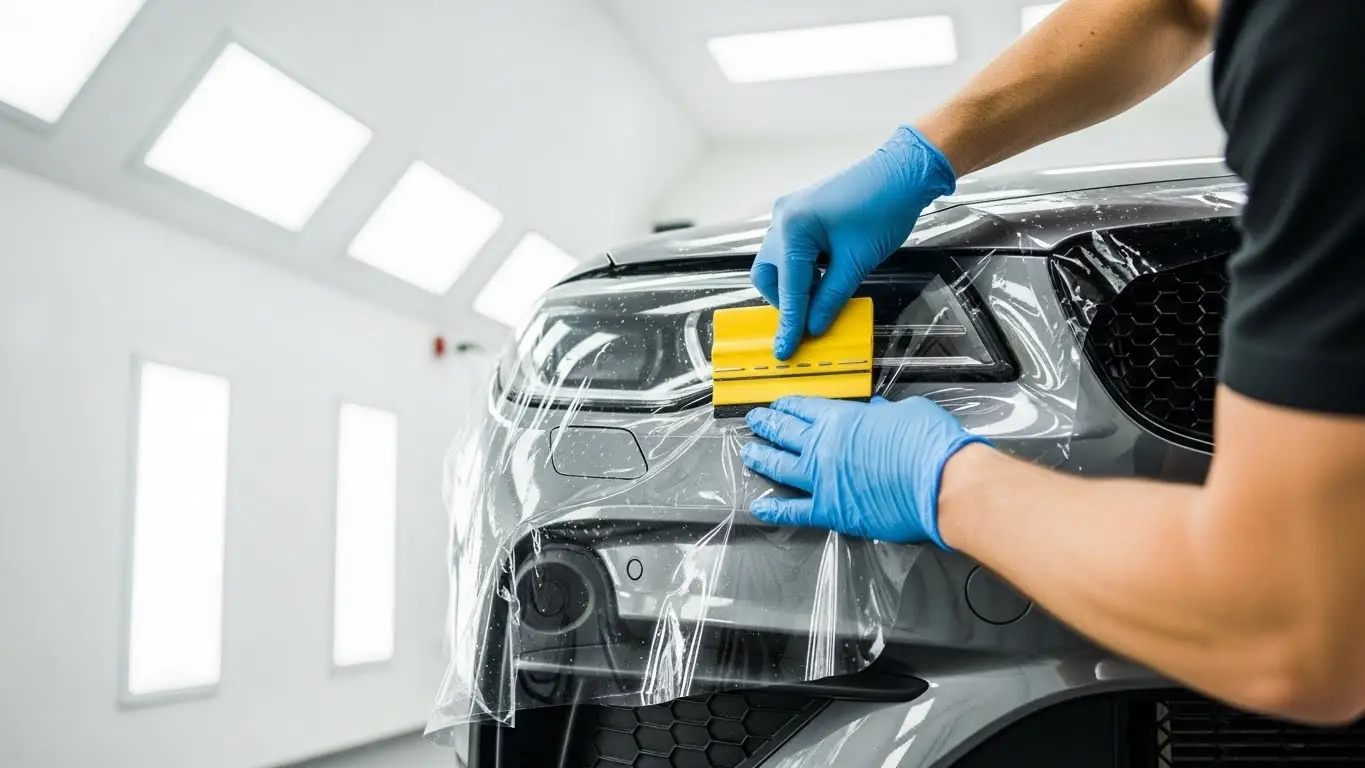
When I walk into a clean room for an install, the environment feels more like a hospital operating theater than a garage. Dust is the enemy. A single speck of dust under the film creates a "tent" that looks like a zit on your car's paint.
The Fluids: Slip vs. Tack
We use two different solutions during installation, and balancing them is an art form.
- Slip Solution: Usually baby shampoo and water. This allows the film to float over the panel so we can align it.
- Tack Solution: An alcohol-water mix or specialized gel. When we squeegee this out, the alcohol evaporates quickly, causing the adhesive to bite instantly.
The Stretch
TPU is elastic, but it has a memory. If you stretch it too much (over 10-15% tension), you get "stretch marks" or adhesive distortion. This looks like striations in the glue. A pro knows exactly how much tension to apply to wrap a bumper curve without breaking the limits of the material.
DIY PPF: Is It Feasible? (The Honest Truth)
Can you install PPF yourself? Technically, yes. Should you? That depends entirely on your patience and the shape of your car.
In my years of training installers, I’ve seen that the learning curve for PPF is significantly steeper than vinyl wrapping. Vinyl is dry; PPF is wet. It’s like trying to wrap a wet noodle around a bowling ball while trying to squeegee water out from under it.
When to Attempt DIY
If you are looking to protect a flat hood, a roof, or door sills, DIY is feasible. These surfaces don't require heavy stretching. You can buy pre-cut kits that fit reasonably well.
When to Call a Pro
If you are looking at a modern bumper with complex curves, massive air intakes, and radar sensors—do not attempt this as your first project. You will likely end up with "fingers" (bunches of film that won't lay flat) or lift lines.
Common DIY Failure Points:
- Lift Lines: If you stop your squeegee stroke halfway through, you leave a permanent line in the adhesive. You must be fluid and continuous.
- Silvering: If you trap the slip solution under the film and don't squeegee it out hard enough, it leaves a silvery, metallic look as the water evaporates and leaves air pockets.
- Contamination: Unless you have a sealed garage and wet the floor to keep dust down, you will get debris under the film.
Maintenance & Longevity
Once the PPF is on, the job isn't done. While TPU is durable, it isn't invincible.
The "Ceramic Combo"
The gold standard in protection right now is PPF topped with a Ceramic Coating. PPF provides the impact resistance, while the ceramic coating provides the hydrophobicity (water beading) and UV protection.
Note: You must coat over the PPF, not under it. Coating under the PPF can interfere with the adhesive bonding to the paint.
Washing Protocol
- Pressure Washers: Be careful. If you blast the edge of the PPF with high pressure, you can inject water under the film and lift it. Keep the nozzle at least 12 inches away and avoid spraying directly at edges.
- Yellowing: Older PVC films turned yellow because UV light broke down the adhesive. Modern TPU films use UV-stable adhesives. If you buy a reputable brand, it shouldn't yellow for at least 7-10 years.
FAQ: Quick Answers
Does PPF damage new paint when removed?
No. If your car has factory original paint (OEM), PPF removal is safe even after years. However, if your car has been repainted by a body shop, there is a risk that the adhesive could pull the paint up if the prep work wasn't perfect.
Can I take my car through an automatic car wash with PPF?
Ideally, no. While the film can handle the brushes better than your paint can, automatic washes often use harsh chemicals that can dull the film's surface over time. Touchless washes are safer, but hand washing is best.
How long does it take for bubbles to go away?
After installation, you might see small water bubbles. This is normal. Since PPF is porous on a microscopic level, this moisture will evaporate (breathe out) over 1–2 weeks depending on the temperature. Do not poke them!
Conclusion
Is PPF worth the cost? If you view your vehicle as an appliance to get from A to B, perhaps not. But if you see your vehicle as an investment, or if you simply take pride in a flawless finish, it is the single most effective protection money can buy.
Think of PPF as a sacrificial layer. It takes the beating so your factory paint doesn't have to. Five years down the road, when you peel that film off to reveal brand-new paint underneath, you'll understand the value—especially when it comes time for resale.
If you are ready to explore high-quality films or need more technical advice on specific applications, stick with Colorfuul. We are here to help you make the right choice for your ride.


