



Popular Articles
Ultimate Guide to 360° Comprehensive Interior Detailing — Deep Clean, Sanitize and Protect Your Car’s Cabin
2026.02.04
Singapore Car Window Tinting Guide: Rules, Benefits, and How to Choose the Right Film
2026.02.04
The Complete Guide to Colour Wraps — Transforming Your Car’s Look with Style and Protection
2026.02.04

About Company
Colorfuul is a global leader in high-end automotive films, offering Color TPU PPF, Transparent PPF, PET Window Films, and Vinyl Wrapping. With exports to over 100 countries, we deliver consistent quality, competitive pricing, and professional service. Beyond production, we provide OEM/ODM customization, shaping the future of automotive aesthetics.
 mary@colorfuul.com
  86 13541196952
 PPF vs. Vinyl Wrap in 2025: Top Brands, Trending Colors, and Which Protection is Right for You
Your heart wants a Satin Black color change to make your car look like the Batmobile, but your brain is screaming about rock chips and highway debris. For years, this was the ultimate dilemma for car enthusiasts: choose style (Vinyl) or protection (PPF). You rarely got both.
But as we settle into 2025, the manufacturing landscape has shifted dramatically. The line between these two products is blurring. At Colorfuul, we’ve watched the chemistry evolve firsthand on our production lines—from simple PVC sheets to complex, multi-layered TPU films that heal themselves when scratched.
If you are trying to decide where to invest your money this year, you need more than just a sales pitch. You need to understand the material science, the real-world costs, and why the "old rules" of wrapping no longer apply.
Here is the definitive manufacturer’s guide to PPF vs. Vinyl Wrap in 2025.
The Core Differences: Material Science 101
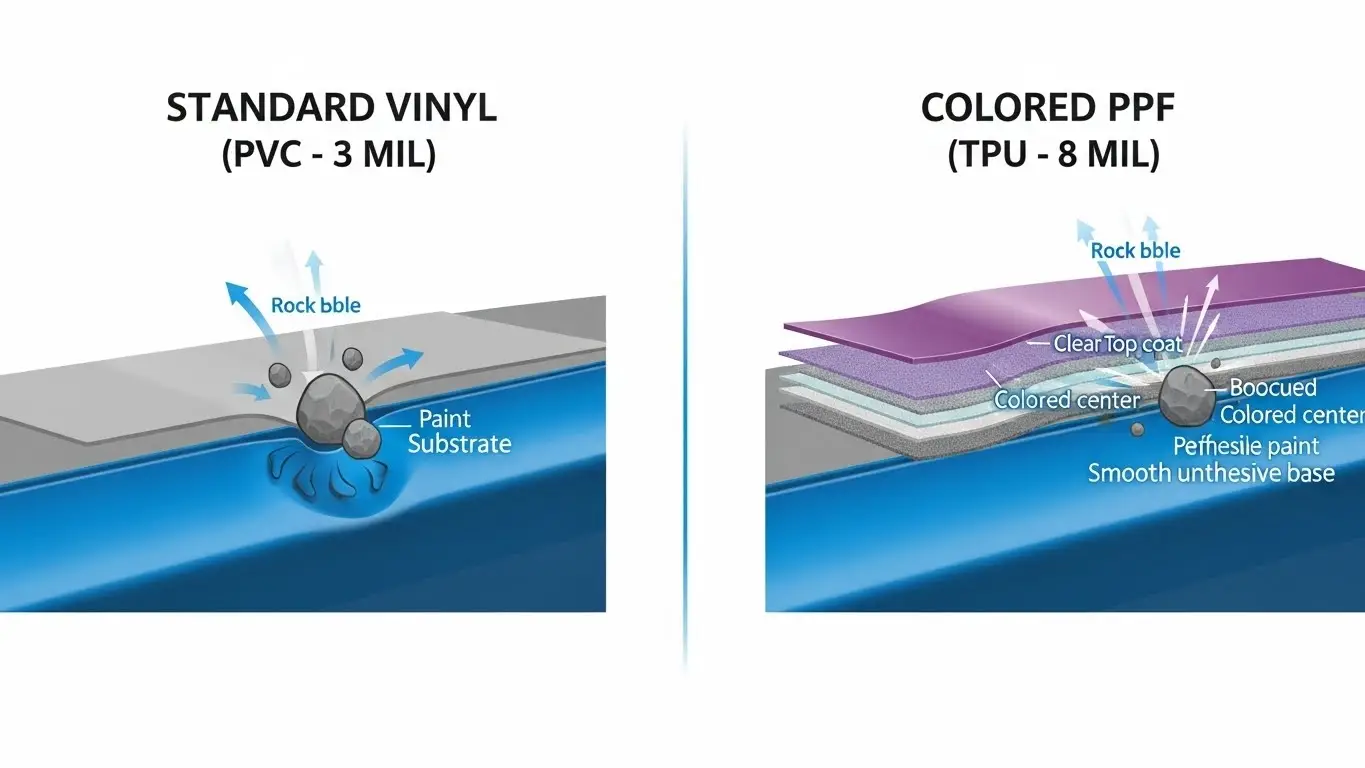
To make the right choice, you have to understand what you are actually sticking to your paint. As manufacturers, we treat these as two completely different classes of material.
Vinyl Wrap (PVC)
Think of vinyl as a high-tech sticker. It is made from Polyvinyl Chloride (PVC).
- Thickness: 3–4 mils (very thin).
- Primary Job: Aesthetic change. It’s flexible and easy to print on, which is why it comes in thousands of colors.
- Protection: Minimal. It stops UV rays and bird droppings, but a flying rock on the highway will punch right through it and chip your paint.
Paint Protection Film (PPF)
Think of PPF as transparent armor. It is made from Thermoplastic Polyurethane (TPU).
- Thickness: 8–10 mils (thick and impact-absorbing).
- Primary Job: Physical defense. The urethane absorbs impact energy from rocks and debris.
- Key Feature: Self-healing. Because TPU is an "elastomer," it can rearrange its polymer chains when heated, making swirl marks and light scratches disappear effectively forever.
Tip: For a deeper dive on keeping these films looking new, check out ourcomprehensive PPF maintenance guide.
The "Orange Peel" Factor
Here is what most shops won't tell you: Vinyl often suffers from "orange peel"—a texture that looks like the skin of an orange rather than smooth glass. Because PVC is rigid, it doesn't flow flat like liquid paint. High-quality PPF (and the new Colored PPF we manufacture) uses a wet-cast method that results in a finish that is often flatter and glossier than your car’s factory clear coat.
The 2025 Game Changer: Colored PPF (Fashion PPF)
This is where the market has changed. In the past, if you wanted Nardo Grey, you had to buy vinyl. If you wanted protection, you bought Clear PPF.
Enter Colored PPF.
This is a TPU-based film that is pigmented with color. It gives you the best of both worlds: the custom color of a wrap with the 8-mil thickness and self-healing properties of PPF.
Why it’s winning in 2025:
- Real Paint Depth: It looks like wet paint, not plastic.
- No "Dry" Look: Standard vinyl wraps often look dry and brittle after 2 years in the sun. TPU remains hydrated and glossy for 7–10 years.
- Scratch Healing: You can wash a Black Colored PPF car without fear of swirl marks. Try that with Gloss Black Vinyl, and you’ll see scratches within a week.
Top Brands for 2025: The Manufacturer's Tier List
Not all films are created equal. Based on adhesive chemistry and clarity, here is how the top players stack up this year.
Best for Pure Protection (Clear PPF)
- XPEL (Ultimate Plus): The household name. consistently good, though you pay a premium for the brand marketing.
- 3M (Scotchgard Pro): Excellent clarity and a very strong warranty network.
- Colorfuul: We focus on the "Direct-to-Consumer" and installer-direct model. By cutting out the middle-man distributors, we offer the same TPU chemical backbone as the big names but at a more accessible price point for bulk projects.
Best for Style (Vinyl Wrap)
- Avery Dennison (SW900): The installer’s favorite. It’s incredibly easy to apply, which means fewer mistakes on your car.
- Inozetek: Known for their "Super Gloss" line. It looks amazing but is notoriously difficult to install. Ensure your shop is experienced with this brand.
- 3M (2080 High Gloss): Reliable, consistent, and they recently solved their surface hazing issues with a new protective cap sheet.
Best for The Hybrid (Colored PPF)
- STEK (Dyno Series): One of the pioneers in fashion PPF. They have great patterned films (carbon fiber, camo).
- Colorfuul: We have optimized our colored TPU to be slightly more hydrophobic (water-repelling) than standard competitors, ensuring that colors like Midnight Purple stay clean even in rainy climates.
Trending Colors for 2025
If you are wrapping your car this year, these are the shades dominating the order banks.
- Midnight Purple: A nod to the legendary Nissan Skyline R34 heritage. The 2025 versions have deep metallic flakes that shift from purple to black.
- Nardo Grey / Brooklyn Grey: The "flat grey" trend isn't dying; it’s evolving into slightly warmer, concrete tones. It looks incredibly modern on almost any vehicle.
- Satin Dark Basalt: A step away from the played-out "Matte Black." This is a metallic charcoal with a satin sheen—stealthy but expensive-looking. (Unsure if satin is right for you? Read our Matte PPF vs Gloss maintenance comparison).
- Liquid Copper / Rose Gold: These high-impact metallics are huge for show cars this year.
- British Racing Green: A sophisticated classic that is making a massive comeback, especially on luxury SUVs and sedans.
Cost & ROI Analysis: The Real Numbers
This is usually where the sticker shock happens. But when you break it down by Cost Per Year, the math changes. Before diving into the numbers, it is worth understanding the factors that influence labor pricing in our PPF installation cost guide.
| Feature | Vinyl Wrap (PVC) | Colored PPF (TPU) |
| Initial Cost | $2,500 – $4,000 | $5,000 – $8,000 |
| Lifespan | 3 – 5 Years | 7 – 10 Years |
| Self-Healing | No (Scratches stay) | Yes (Heat heals scratches) |
| Removal Labor | High (Risk of cracking) | Low (Peels off clean) |
| Resale Value | Neutral (Styles vary) | Positive (Protects paint) |
The Hidden Cost of Vinyl:
If you leave a vinyl wrap on for 6 years, the sun will bake the PVC onto your paint. Removing it becomes a nightmare that charges by the hour—sometimes costing $1,000+ just to strip the old film. PPF does not have this issue; it is designed to peel off cleanly even a decade later.
Decision Guide: Which One is For You?
Still on the fence? Here is a simple decision tree we use when advising clients.
Scenario A: The Leaser / The Hopper
"I lease my car, or I get bored and change cars every 2 years."
Verdict: Go Vinyl. There is no point paying for 10-year protection on a car you will give back in 24 months. Save the money and get the look you want.
Scenario B: The Keeper
"I bought my dream car and I plan to keep it forever."
Verdict: Go PPF (Clear or Colored). Vinyl will disappoint you after year 3 when it starts to dull. PPF keeps the car looking showroom fresh for a decade, protecting your investment.
Scenario C: The Perfectionist
"I want a custom color, but I can't stand swirl marks."
Verdict: Go Colored PPF. If you choose a black vinyl wrap, you will see scratches. If you choose Black PPF, you will see a mirror. It is the only choice for perfectionists.
Conclusion
In 2025, you no longer have to compromise. While standard Vinyl Wrap is still the king of affordable, short-term customization, Colored PPF has emerged as the superior choice for daily drivers and luxury vehicles. It bridges the gap between the "fun" of a color change and the "function" of military-grade armor.
Whether you choose simple vinyl accents or a full body TPU shield, the most important factor is the material quality. Cheap films fail quickly. At Colorfuul, we engineer our films to withstand the harshest elements so you can drive with confidence.
Ready to see the difference? Visit our catalog to explore our 2025 collection of high-gloss TPU films and order a sample swatch today.
FAQ
Can you put ceramic coating on vinyl wrap?
Yes, and you should. A ceramic coating (specifically one designed for films) helps reduce the surface tension, making the vinyl easier to clean and protecting it from UV fading.
Does PPF damage paint when removed?
No—provided your car has factory original paint. If your car has been repainted cheaply, there is always a slight risk that any film could lift the paint. On OEM paint, PPF is 100% safe.
Is colored PPF worth the extra money?
If you drive on highways, yes. One repainted bumper from rock chips can cost $1,000. Colored PPF prevents that damage entirely, paying for itself in resale value and saved body shop visits.
How long does vinyl wrap last in the sun?
On horizontal surfaces (hood, roof), expect 2–3 years before you see fading or hazing. Vertical surfaces (doors) can last 4–5 years. PPF generally lasts double this duration.
Can you mix PPF and Vinyl?
Absolutely. A popular "budget-friendly" combo is to put Clear PPF on the front bumper and hood (high impact zones) and use Vinyl Wrap on the rest of the car to match the color.


