



Popular Articles
Ultimate Guide to 360° Comprehensive Interior Detailing — Deep Clean, Sanitize and Protect Your Car’s Cabin
2026.02.04
Singapore Car Window Tinting Guide: Rules, Benefits, and How to Choose the Right Film
2026.02.04
The Complete Guide to Colour Wraps — Transforming Your Car’s Look with Style and Protection
2026.02.04

About Company
Colorfuul is a global leader in high-end automotive films, offering Color TPU PPF, Transparent PPF, PET Window Films, and Vinyl Wrapping. With exports to over 100 countries, we deliver consistent quality, competitive pricing, and professional service. Beyond production, we provide OEM/ODM customization, shaping the future of automotive aesthetics.
 mary@colorfuul.com
  86 13541196952
 TPU vs. TPH: Which Paint Protection Film Technology is Right for Your Business?
If you’ve spent any time in the auto detailing or paint protection industry lately, you’ve likely noticed the market is flooded with acronyms. PVC, TPH, TPU, TPO—it’s enough to make your head spin. But for shop owners and installers, this isn't just alphabet soup; it’s a critical business decision.
Visually, a fresh roll of TPH and a fresh roll of TPU can look nearly identical. They both shine, they both feel like plastic, and they both cover a car. But the similarities stop at the surface.
At Colorfuul, we approach this from a manufacturing perspective. We know that what happens at the molecular level dictates what happens on the road three years from now. Choosing the wrong material can lead to warranty nightmares, angry customers, and a damaged reputation. Conversely, understanding the chemistry helps you sell the right product to the right customer.
In this guide, we’re going to dissect the real differences between TPU and TPH technologies, moving beyond marketing fluff to look at the engineering reality.
What is TPH? (The Hybrid Solution)
To understand TPH, we first have to look at its predecessor: PVC (Polyvinyl Chloride). Traditional PVC films—often used in color change wraps—are naturally rigid. To make them usable for paint protection, manufacturers add chemical plasticizers to soften the material.
TPH stands for Thermoplastic Polyurethane Hybrid.
Think of TPH as a "bridge technology." It is essentially a PVC base material that has been enhanced with plasticizers and often capped with a very thin coating to mimic the properties of higher-end films.
The Chemistry of the "Hybrid"
The "H" in TPH is doing a lot of heavy lifting. Manufacturers blend PVC with specific chemical additives to increase flexibility and clarity. However, the fundamental weakness remains: Plasticizer Migration.
Over time, UV exposure and heat cause these plasticizers to separate from the PVC base. When the plasticizers migrate out, the film attempts to return to its natural, rigid state. This is why older or cheaper films eventually crack or turn brittle. While TPH is chemically more stable than raw PVC, it is still fighting a losing battle against physics.
The Bottom Line on TPH
- Pros: It’s significantly cheaper to manufacture, making it an attractive entry-level option.
- Cons: It lacks "memory" (stretchability), has lower impact resistance, and is prone to yellowing faster than TPU.
- Best For: Short-term leases, economy vehicles, or customers on a strict budget who understand the limitations.
What is TPU? (The Gold Standard)
TPU stands for Thermoplastic Polyurethane.
In the world of high-end manufacturing, this is the benchmark. Unlike PVC-based films, TPU does not rely on added plasticizers to be flexible. The polymer chain itself is soft and elastic by nature. This means there are no chemicals to "migrate" out over time, resulting in a film that stays flexible for 5, 7, or even 10+ years. For a deeper dive into how material choices impact long-term performance, you can read our guide on colored PPF lifespan and durability.
Aliphatic vs. Aromatic
Not all TPU is created equal. Early generations used Aromatic polyurethanes, which were strong but turned yellow quickly under sunlight (UV radiation).
Modern premium films, like the ones we engineer at Colorfuul, utilize Aliphatic Polyurethane. The chemical structure of aliphatic compounds is stable against UV oxidation. This is why high-quality TPU films remain invisible on white cars for years.
The "Self-Healing" Science
You’ve seen the videos of scratches disappearing with heat. This isn't magic; it's thermal plasticity. Because the TPU structure is a "tangled mess" of long polymer chains (rather than a rigid grid), adding heat allows these chains to rearrange themselves back to their original, chaotic state, effectively closing up minor scratches.
Key Performance Comparison
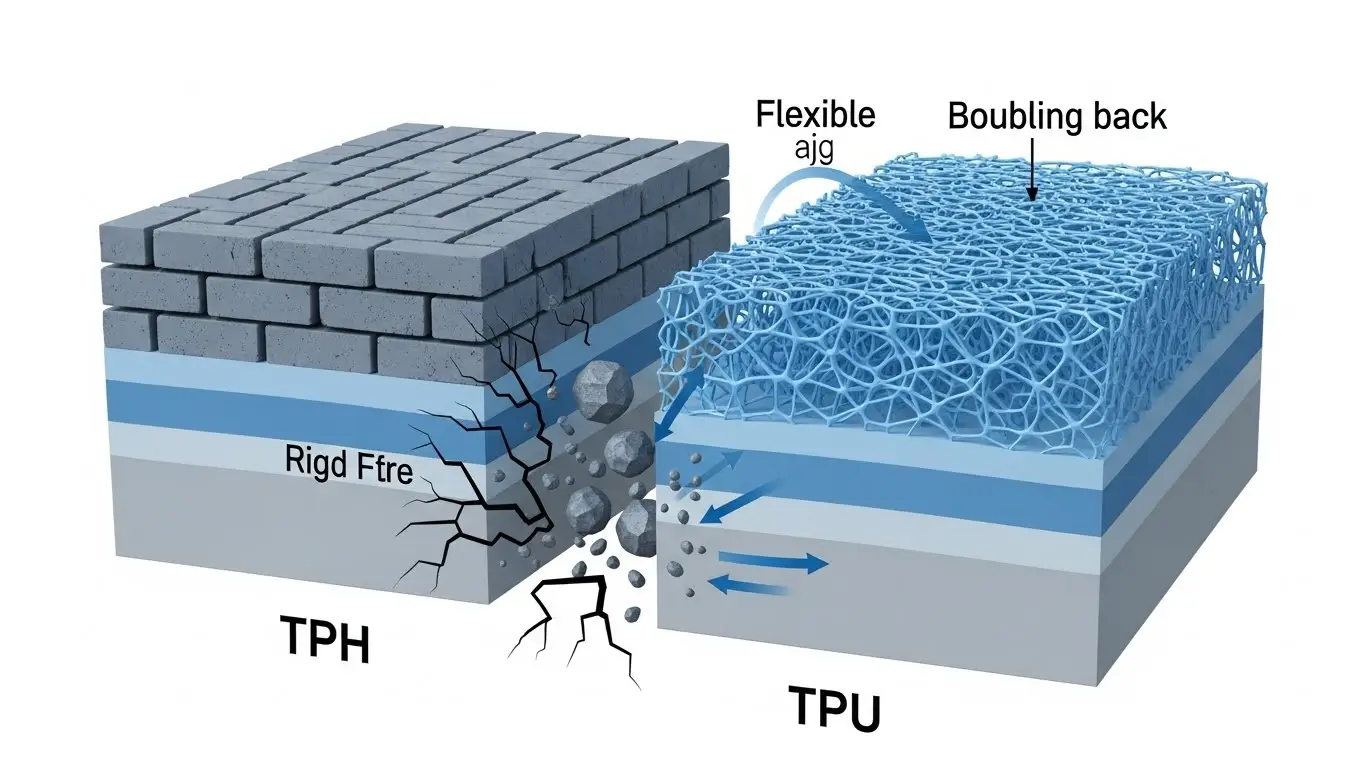
When you are selling a package to a client, you need to articulate why they should pay more for TPU. Here is the technical breakdown.
Durability & Impact Resistance
Imagine throwing a rock at a brick wall versus throwing it at a rubber tire.
- TPH (The Brick Wall): It is harder and stiffer. When a rock hits it at highway speeds, the energy concentrates in one spot, often leading to a puncture or a chip in the film.
- TPU (The Rubber Tire): It is softer and absorbs energy. Upon impact, the material deforms to absorb the blow and then bounces back. This energy absorption is what actually protects the paint underneath.
Yellowing & UV Stability
Yellowing is the number one complaint in the PPF industry.
- TPH: Because it relies on PVC chemistry, UV rays break down the chloride bonds over time, releasing gas and causing discoloration. It will eventually yellow—it’s just a matter of when.
- TPU: High-grade Aliphatic TPU is chemically inert to UV radiation. It is transparent to UV rays, allowing them to pass through to the paint (fading the paint at the same rate as the rest of the car) without degrading the film itself.
Hydrophobicity
Both films can be hydrophobic, but it depends on the top coat. Modern TPU films usually feature an infused top coat that is covalently bonded to the base layer. TPH films often rely on a spray-coating that wears off after a few dozen car washes, leading to a loss of that "beading" effect.
| Feature | TPH Characteristics | TPU Characteristics |
| Material Base | PVC + Plasticizers (Hybrid) | Aliphatic Polyurethane |
| Flexibility | Limited stretch, stiffer | High elasticity (300%+ Elongation) |
| Lifespan | 2-3 Years (Realistic) | 7-10 Years |
| Burn Test | Black smoke, soot, char | Clear melt, white smoke |
| Best For | Budget Installs | Premium Protection |
Installation: The Installer's Perspective
If you are the one holding the squeegee, the material difference is night and day. Labor is your biggest cost, and TPH can be a profit killer in the install bay.
Stretch and Conformability
TPU films typically offer 300-400% elongation at break. You can pull a bumper corner, heat it, and the film complies.
TPH, being PVC-based, has a "memory" of being flat. It fights you. When you stretch TPH around a mirror cap or a complex bumper curve, it wants to shrink back. This leads to:
- Fingers/Lift Lines: The film pulls back, creating air pockets at the edges.
- Silvering: The adhesive gets over-stressed, leaving unsightly stretch marks.
The Adhesive Factor
Adhesive chemistry must match the film substrate. TPU adhesives are designed for clean removal. TPH adhesives often bond aggressively to the PVC. We have seen horror stories where removing cheap TPH film after 4 years leaves 90% of the glue on the car—or worse, pulls clear coat with it.
Real-World Testing: How to Spot the Difference
Suppliers might mislabel boxes. How can you, as a shop owner, verify what you just bought? Here are three tests we recommend.
The Stretch Test
Cut a 1-inch strip of the film. Grip it tightly and pull until it breaks.
- TPU: Will stretch incredibly far (like a rubber band) before snapping. When it snaps, it usually creates a wavy, curled edge.
- TPH: Will stretch a little (perhaps 50-100%) and then snap abruptly. The break point often looks whitened or stressed.
The Burn Test
This is the most definitive field test. Take a lighter to a scrap piece.
- TPH (PVC): Will burn with black, sooty smoke. It will smell strongly of burning plastic and leave a hard, charred, black residue.
- TPU: Will melt rather than burn. If it catches fire, the smoke is usually white or clear. It leaves a gooey, liquid-like substance rather than hard char.
The Smell Test
Unroll the film and smell the adhesive side.
- TPH: Usually carries a strong, sharp chemical solvent smell (from the plasticizers).
- TPU: Should be odorless or have a very faint, neutral scent.
The Business Case: ROI and Reputation
From a pure numbers standpoint, TPH raw material is roughly 30-40% cheaper than premium TPU. For a high-volume shop, that savings looks tempting on a spreadsheet.
However, consider the Total Cost of Ownership:
- Reputation Risk: If you sell a "Premium Package" using TPH, and that customer returns in 18 months with a yellow bumper, you haven't just lost a customer; you've lost every referral they would have sent you.
- Labor Efficiency: If your installers take 20% longer to install TPH because it's stiff, you have burned your material savings on labor hours.
Recommendation: It is perfectly acceptable to stock TPH as an "Economy" or "Lease Return" package, provided you are transparent with the customer. But for your flagship protection packages—the ones you put your brand name behind—Aliphatic TPU is the only viable option for long-term business growth.
Conclusion
The market is evolving. While TPH served a purpose as a budget alternative in the past, the gap in manufacturing technology is widening. TPU offers the tensile strength, optical clarity, and longevity that modern car owners expect.
For distributors and shops, the choice comes down to your business model. Are you looking for the lowest upfront cost, or are you building a brand based on quality and longevity?
At Colorfuul, we focus on engineering Aliphatic TPU films that make the installer's life easier and the car owner's investment safer. By understanding the chemistry, you can confidently explain the value to your customers, justifying premium pricing for a premium product.
Frequently Asked Questions
Does TPH film yellow over time?
Yes. Due to its PVC chemical base and the presence of plasticizers, TPH degrades under UV light, leading to discoloration (yellowing) typically within 1–2 years depending on sun exposure.
Can you install TPH on white cars?
We do not recommend it. White paint shows the slightest yellowing of the film immediately. For white vehicles, Aliphatic TPU is the only safe choice to ensure the car stays white, not creamy yellow.
What is the price difference between TPU and TPH?
Generally, TPH raw material costs 30% to 50% less than high-quality TPU. However, the installation labor cost remains the same (or higher for TPH due to difficulty), making the final savings to the customer less drastic than the material cost suggests.
Is TPH better than Vinyl (PVC)?
Yes. TPH is chemically an improvement over standard calendared PVC vinyl. It is more flexible and clearer, but it still falls short of the performance benchmarks set by Polyurethane (TPU).
How long does TPU PPF last compared to TPH?
A high-quality Aliphatic TPU film typically lasts 5 to 10 years without cracking or significant yellowing. TPH films generally have a service life of 2 to 3 years before visual degradation begins.


