



Popular Articles
Ultimate Guide to 360° Comprehensive Interior Detailing — Deep Clean, Sanitize and Protect Your Car’s Cabin
2026.02.04
Singapore Car Window Tinting Guide: Rules, Benefits, and How to Choose the Right Film
2026.02.04
The Complete Guide to Colour Wraps — Transforming Your Car’s Look with Style and Protection
2026.02.04

About Company
Colorfuul is a global leader in high-end automotive films, offering Color TPU PPF, Transparent PPF, PET Window Films, and Vinyl Wrapping. With exports to over 100 countries, we deliver consistent quality, competitive pricing, and professional service. Beyond production, we provide OEM/ODM customization, shaping the future of automotive aesthetics.
 mary@colorfuul.com
  86 13541196952
 What Is the Thickest PPF Film Available in 2026?
As of 2026, the thickest commercially available Paint Protection Film (PPF) for consumer vehicles typically falls between 10 to 14 mils, depending on the brand and specific "off-road" or "heavy-duty" package selected. While the industry standard remains consistent at 7.5 to 8 mils, specialized impact films designed for track cars, off-road vehicles, and high-wear areas have pushed the limits to offer nearly double the protection. It is important to note that while industrial films can go thicker, 14 mils is generally the ceiling for automotive applications due to the difficulty of installing such rigid material around complex curves and body lines.
What Does "Mils" Mean in Paint Protection Film?
To understand thickness, you first need to understand the unit of measurement. In the automotive film industry, thickness is measured in mils. One mil is equal to one-thousandth of an inch (0.001 inch).
For context, a standard piece of credit card plastic is roughly 30 mils thick. Standard automotive PPF is usually 8 mils, comprising three layers: the adhesive, the polyurethane impact layer, and the self-healing top coat. When we talk about "thick" PPF in 2026, we are looking for anything exceeding the 10-mil benchmark, which offers significantly higher impact resistance against rock chips and road debris.
Image Suggestion:
- Visual: A cross-section diagram showing the layers of PPF (Adhesive, TPU Core, Top Coat) with measurement markers.
- Alt Text: Diagram showing layers of automotive paint protection film and thickness in mils.
Is Thicker PPF Always Better for Your Car?
The short answer is: not always. While thicker film offers superior impact protection, it is stiffer and harder to install, making it less suitable for cars with aggressive curves or intricate bumpers.
Thicker film (10-12 mil) acts as superior armor. It is best used on flat, high-impact areas like hoods, rocker panels, and fenders. However, because it lacks the pliability of standard 8-mil film, it can leave stretch marks or lift at the edges if forced around tight corners. When choosing your film, you must balance protection needs with the aesthetic finish.
This decision often involves understanding the material science behind the film. For a deeper dive into material quality, it helps to understand TPU vs TPH film technology to ensure you aren't just getting a thick piece of plastic, but high-quality protection.
What Is the Difference Between 8 Mil and 10 Mil PPF?
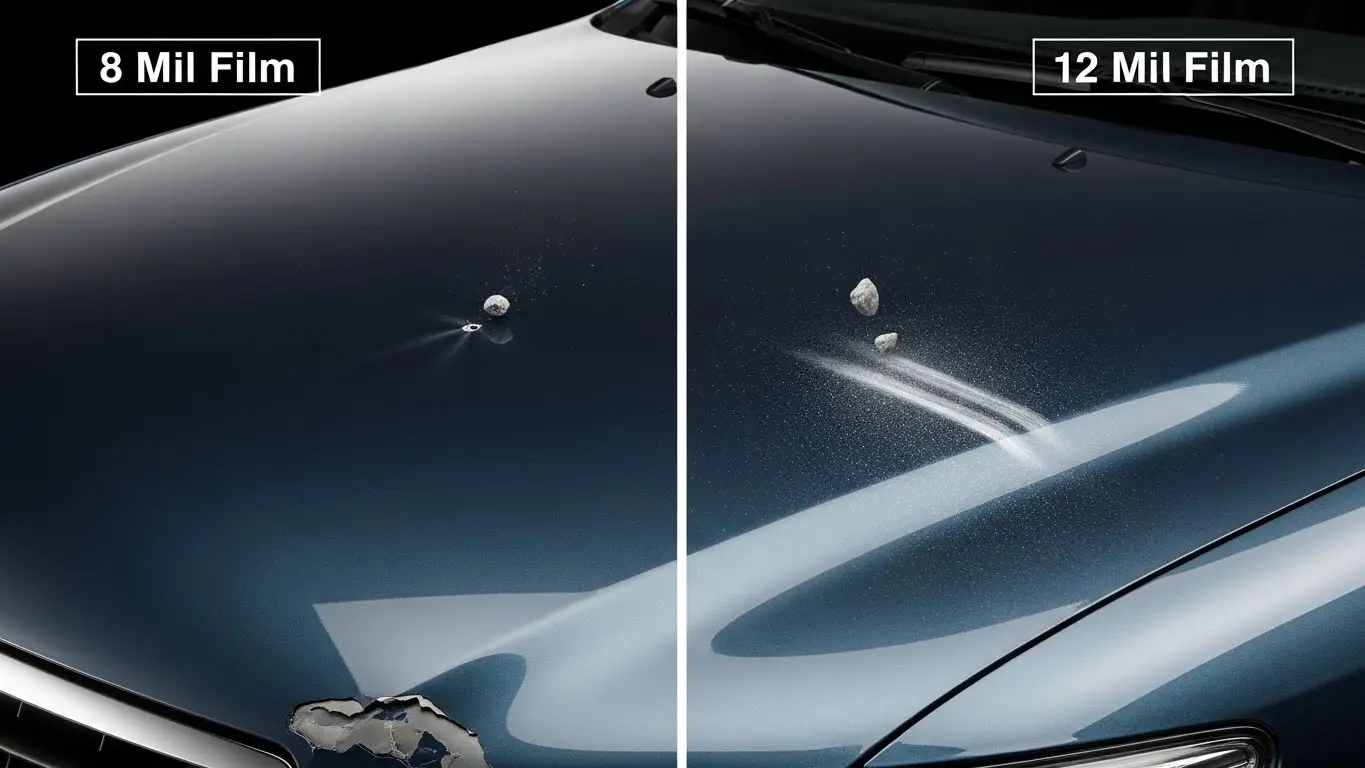
8-mil film is the industry standard for daily driving, while 10-mil+ film is specialized for heavy-duty protection against larger debris and high-speed impacts.
Here is a breakdown of how they compare in practical application:
| Feature | Standard PPF (8 Mil) | Heavy-Duty PPF (10-12 Mil) |
| Impact Resistance | Moderate (Standard road gravel) | High (Larger rocks, track debris) |
| Flexibility | High (Fits complex curves easily) | Low (Best for flat surfaces) |
| Clarity | Invisible/Glass-like | Slight texture possible (Orange peel) |
| Installation | Easier, lower labor cost | Difficult, higher labor cost |
| Best Use | Full body wraps | Rocker panels, hoods, off-road |
Choosing the right thickness often comes down to where you drive. If you are tracking your car or driving on gravel, the extra thickness is essential.
Does Thicker PPF Still Have Self-Healing Properties?
Yes, high-quality thick PPF retains self-healing top coats, allowing minor swirls and scratches to disappear with heat.
Just because a film is rugged doesn't mean it loses its cosmetic benefits. The best heavy-duty films in 2026 utilize advanced Aliphatic TPU film, which prevents yellowing and maintains clarity even at greater thicknesses. The self-healing layer sits on top of the thickened impact layer.
If you are curious about the science behind this feature, you can read more about how self-healing PPF works to understand why the top coat thickness remains relatively constant even as the impact layer grows thicker.
Cost and Material Considerations
Thicker films are invariably more expensive. This is due to the increased amount of raw TPU (Thermoplastic Polyurethane) required and the specialized manufacturing process needed to keep the film optically clear.
Vinyl vs. PPF Thickness
It is a common misconception that vinyl wraps offer similar protection because they can feel thick. However, vinyl is primarily for color change, not impact. When comparing TPU vs PVC wraps, you will find that even a thick PVC vinyl offers a fraction of the impact absorption of a specialized 10-mil TPU film.
Budgeting for Protection
If budget is a concern, some vehicle owners consider mixing materials. However, be cautious about low-cost alternatives. The price gap is often discussed in TPH vs TPU PPF comparisons, where cheaper TPH hybrids offer thickness but lack the longevity and elasticity of true TPU.
Image Suggestion:
- Visual: A side-by-side photo of a car hood half-covered in 8-mil and half in 12-mil PPF (indistinguishable to the eye) but with a "High Impact" icon over the 12-mil side.
- Alt Text: Comparison of standard paint protection film versus heavy-duty thick PPF on a vehicle hood.
Frequently Asked Questions
Can I layer PPF to make it thicker?
Technically, yes, you can stack two layers of PPF. However, this is rarely recommended as it can distort the paint's clarity, double the cost, and make removal extremely difficult. It is better to buy a single layer of 10 or 12-mil film.
Does thick PPF look different on the car?
Premium thick films are optically clear, but as you approach 12-14 mils, you may notice a slight increase in "orange peel" (texture) compared to factory paint. For most off-road applications, this trade-off is acceptable for the added protection.
How long does thick PPF last?
Like standard PPF, heavy-duty films generally carry a warranty of 7 to 10 years, provided they are maintained correctly. The thickness contributes to physical durability, but the lifespan is determined by the adhesive and top coat quality.
Is 10 mil PPF bulletproof?
No, no PPF is bulletproof. 10-mil film is designed to stop rock chips, scratches, and minor abrasions. It will not stop bullets or heavy collision damage.
Key Takeaways
- Standard vs. Thick: Standard PPF is ~8 mils; "Thick" PPF is 10-14 mils.
- Application Matters: Use thick film for flat, high-impact areas (bumpers, hoods) and standard film for complex curves.
- Material Quality: Ensure you are buying Aliphatic TPU, not PVC or TPH, to prevent yellowing.
- Trade-offs: Thicker film offers better protection but is harder to install and may cost significantly more.
Conclusion
In 2026, if you are looking for the ultimate shield for your vehicle, 10 to 14-mil PPF is the gold standard for impact resistance. While it requires a skilled installer and a higher budget, the peace of mind it offers for track days and off-roading is unmatched. Assess your driving habits, check your budget, and choose the thickness that fits your lifestyle.
Ready to protect your investment? Consult with a certified installer today to see if 10-mil PPF is right for your vehicle.


